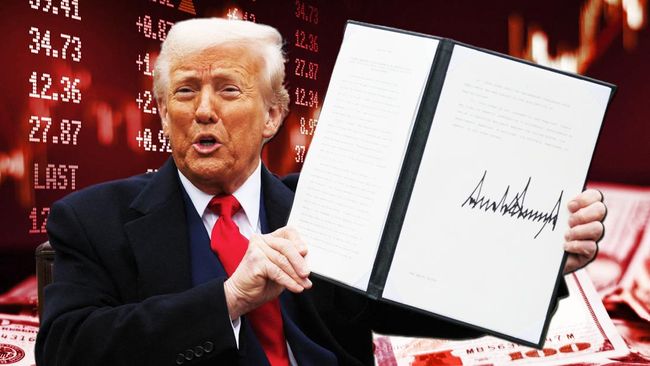
It's already happening, the US tariff on Indonesia is 32%, one of the highest one

Not convinced of the positive effects. This is essentially a tax on US businesses and consumers. Either prices stay the same and business performance decreases, or prices increase and consumer purchasing power decreases. None of this is good for the US Economy in my opinion, but we'll see, I'm no economist. But for me, it feels like increased taxes on businesses and the average joe, disguised as a nationalist policy.
This is a bit like the rationale of the IMF and its dealing with so called Third World countries. Loans are made often made on the basis of the country rescinding subsidies on commodities such as fuel, rice or whatever. The balance sheet looks good but the poor are crushed. And like the creation of industrial zones communities where people were once farmers. The locals working in the factories might now be earning $50 and previously only earned maybe $5. So the raw statistics suggest the community is better off. Whereas once the community lived off the land and though $ poor had an overall better quality of life than in the industrial zone where they now have to pay much more for everything including food and living in squalid cramped housing with a much worse quality of life.
 
Let’s take a relevant example: Palm oil.

Products like granola bars, cookies, crackers, chips and other packaged snacks, bread, cakes, pastries, pizza dough, chocolate (spread), candy and other sweets, instant noodles, frozen meals, margarine and other butter alternatives, breakfast cereals and ice cream contain palm oil. Just to name a few.

So will the US develop their own palm plantations? Don‘t think so. Perhaps the big manufacturers will purchase in other countries as Malaysia, Nigeria or Thailand, but it’s probable their prices will be the same and changes in sourcing and QA testing cost money too. Some part of the additional costs will be ‘eaten’ by the producers and importers but not all. So that means inflation.
 
Let’s take a relevant example: Palm oil.

Products like granola bars, cookies, crackers, chips and other packaged snacks, bread, cakes, pastries, pizza dough, chocolate (spread), candy and other sweets, instant noodles, frozen meals, margarine and other butter alternatives, breakfast cereals and ice cream contain palm oil. Just to name a few.

So will the US develop their own palm plantations? Don‘t think so. Perhaps the big manufacturers will purchase in other countries as Malaysia, Nigeria or Thailand, but it’s probable their prices will be the same and changes in sourcing and QA testing cost money too. Some part of the additional costs will be ‘eaten’ by the producers and importers but not all. So that means inflation.
Yes Palm oil is used in countless products, and thats OK. The Problem with Palm oil is the industry has almost completely deforested Kalimantan, Malaysia, and their working on Sumatra! This is Pure and simple Greed, without any consideration. The Planet needs these Rainforests to Produce Oxygen! And What about the Animals that live Only in these places in the entire World? Tigers, Orangutans, Elephants, Pythons, and countless other species, that Can't fight back!
It's Sad, you think of only Inflation! HAH! 🫵💩
Honey, Where's my Perfume made with Ambergris?
I want to say how Thoughtless Humans are for being so inconsiderate, but That's a waste of time. Everyone already knows, but live in Denial! ☹️
 
Last edited:
Yes Palm oil is used in countless products, and thats OK. The Problem with Palm oil is the industry has almost completely deforested Kalimantan, Malaysia, and their working on Sumatra! This is Pure and simple Greed, without any consideration. The Planet needs these Rainforests to Produce Oxygen! And What about the Animals that live Only in these places in the entire World? Tigers, Orangutans, Elephants, Pythons, and countless other species, that Can't fight back!
It's Sad, you think of only Inflation! HAH! 🫵💩
Honey, Where's my Perfume made with Ambergris?
I want to say how Thoughtless Humans are for being so inconsiderate, but That's a waste of time. Everyone already knows, but live in Denial! ☹️
It's nothing new that the environment takes a back seat to greed every time. It's not just here. A lot of mountains in the US have been flattened and their watersheds filled in for a quick dollar. By the way, Sumatra is well past the point of being worked on.
 
Yes Palm oil is used in countless products, and thats OK. The Problem with Palm oil is the industry has almost completely deforested Kalimantan, Malaysia, and their working on Sumatra! This is Pure and simple Greed, without any consideration. The Planet needs these Rainforests to Produce Oxygen! And What about the Animals that live Only in these places in the entire World? Tigers, Orangutans, Elephants, Pythons, and countless other species, that Can't fight back!
It's Sad, you think of only Inflation! HAH! 🫵💩
Honey, Where's my Perfume made with Ambergris?
I want to say how Thoughtless Humans are for being so inconsiderate, but That's a waste of time. Everyone already knows, but live in Denial! ☹️

Mod note: Shadrach, please refrain from posting emojis that may be interpreted as insulting by other members. You don't get to call people pieces of shit here.
 
You are missing out an important part of the process. Indonesia will not be able to increase its prices by 19% because that would make them uncompetitive and buyers would buy the products elsewhere. They will keep prices the same as they currently are and the 19% will have to be swallowed by the Indonesian side as a hit to their profit margin, in other words the tariff will effectively be paid by Indonesia.
(Of course each supplier will have to decide whether to increase prices or not, depending on their market situation)
That would only apply if the US was the sole or dominant buyer of the Indonesian product, and myself, Google, and ChatGPT all can't think of any product that fits that description.

Rubber, palm oil, coffee, clothing, etc. all operate in a very global market, and if the Indonesian producer is faced with selling to the US at a 19% discount or Europe at market rate, they will choose Europe every single time. There will be some negative impact for the Indonesian producer as they may need to find a new buyer and the non-US markets will become a little more competitive, but it won't be nearly as much as the 19% cost which will be borne by the US buyers.
 
How? Practically very economist disagrees with you (and Trump)
Because US buyers will squeeze the sellers to lower the prices to accomodate the tariffs, and lower their margins to sustain the demand, which will spread to the supply chain up to the factory workers and their salaries. For example, palm oil price fluctuates a lot, meaning a lot of margin there.

Second, US asked for opened market, meaning previously unatractive or less attractive products could become attractive,opening new oportunities for them.
 
Because US buyers will squeeze the sellers to lower the prices to accomodate the tariffs, and lower their margins to sustain the demand, which will spread to the supply chain up to the factory workers and their salaries. For example, palm oil price fluctuates a lot, meaning a lot of margin there.

Second, US asked for opened market, meaning previously unatractive or less attractive products could become attractive,opening new oportunities for them.
Not sure about buyers squeezing sellers. Pricing will be calculated on the best profit option. If lower prices produces greater sales volume and more profit then some goods may go down a little. The main pressure comes from competition. Despite laws restricting pricing collusion it is not unknown for secret agreements not to have prices fall below a certain margin.
 
  • Agree
Reactions: Bob
Not sure about buyers squeezing sellers. Pricing will be calculated on the best profit option. If lower prices produces greater sales volume and more profit then some goods may go down a little. The main pressure comes from competition. Despite laws restricting pricing collusion it is not unknown for secret agreements not to have prices fall below a certain margin.
US have many suppliers, so they will compete each other, this is not Indonesia where the import cartel can control the pricing.
 
Because US buyers will squeeze the sellers to lower the prices to accomodate the tariffs, and lower their margins to sustain the demand, which will spread to the supply chain up to the factory workers and their salaries. For example, palm oil price fluctuates a lot, meaning a lot of margin there.

Second, US asked for opened market, meaning previously unatractive or less attractive products could become attractive,opening new oportunities for them.
Commodity prices are generally benchmarked and fluctuate with supply and demand. It depends on tariff rates for other producers but I doubt an attempt to squeeze prices to make up for the tariff would meet success.
Could you explain some on the second paragraph? How would undesirable products become desirable?
 
Could you explain some on the second paragraph? How would undesirable products become desirable?
They will become cheaper and competitive on the Indonesian market, previously unattractive because of pricing.
 
They will become cheaper and competitive on the Indonesian market, previously unattractive because of pricing.
So cheaper because tariffs will be removed? Maybe but we'd need to know what goods are involved.
 
So cheaper because tariffs will be removed? Maybe but we'd need to know what goods are involved.
Harley-Davidson bikes? US cheese?
On the bottom of the article you have the list of Indonesian tariffs to US goods. There is also VAT on top of it and some other fees.

 
Because US buyers will squeeze the sellers to lower the prices to accomodate the tariffs, and lower their margins to sustain the demand, which will spread to the supply chain up to the factory workers and their salaries. For example, palm oil price fluctuates a lot, meaning a lot of margin there.

Second, US asked for opened market, meaning previously unatractive or less attractive products could become attractive,opening new oportunities for them.
You're completely ignoring the global market. If the equilibrium price has been $100/unit, now a US buyer can demand the Indonesian producer to sell it to them for $84 to cover the 19% tariff, but the Indonesian producer will just laugh and sell their whole supply to Europe for $99.
 
You're completely ignoring the global market. If the equilibrium price has been $100/unit, now a US buyer can demand the Indonesian producer to sell it to them for $84 to cover the 19% tariff, but the Indonesian producer will just laugh and sell their whole supply to Europe for $99.
Europe has many tariffs on Indonesian goods. New trade agreement Indonesia-EU will need 18-24 months to get ratified by the parlaments of the member states to get in force. Than, in the meantime, Indonesia can export to other markets, for example to the penguins in Antarctica.
 
Europe has many tariffs on Indonesian goods. New trade agreement Indonesia-EU will need 18-24 months to get ratified by the parlaments of the member states to get in force. Than, in the meantime, Indonesia can export to other markets, for example to the penguins in Antarctica.
1753239403372.png
 
Europe has many tariffs on Indonesian goods. New trade agreement Indonesia-EU will need 18-24 months to get ratified by the parlaments of the member states to get in force. Than, in the meantime, Indonesia can export to other markets, for example to the penguins in Antarctica.
Whatever the equilibrium was, it was already present, the only significant country changing their tariffs is the US, and therefore the US buyer has 19% less buying power of Indonesian products in Q3 2025 than they did in Q1.

The US buyers are by far the most negatively impacted by this agreement. First the importers, and I've got a bridge to sell you if you think they have an extra 19% margin they're willing to give up, so it's passed down to the consumer, and inflation continues.
 
Whatever the equilibrium was, it was already present, the only significant country changing their tariffs is the US, and therefore the US buyer has 19% less buying power of Indonesian products in Q3 2025 than they did in Q1.

The US buyers are by far the most negatively impacted by this agreement. First the importers, and I've got a bridge to sell you if you think they have an extra 19% margin they're willing to give up, so it's passed down to the consumer, and inflation continues.
This is so sad to hear for me, as I used to import from Bali and the Tariff, Duty, or whatever you call it, wasn't so bad. If I brought in 6 cubic mt. Boxes, it was about $300 or $400 to the Government. The import agent wasn't that much. It was a nice business, not much profit, but enough to cover cost, and return to Bali, and do it all over again, for many years. There was no duty on Handicrafts, only Clothes made from Cotton, Rayon, Polyester, or Nylon, Not Silk, Or Wool! Which competed with the US manufacturers. I liked the work, because Every year I would improve my Quality and experience! I also supported about 5 different Bali families, and believe me, over the years, I put a lot of kids through School, and helped buy a lot of Motorbikes! I moved into Silk clothing, which had 0 duty, and the quality was so nice, but it was too pricey for the American Market. ☹️
This business is not going to make any small time importer like me, Rich, but it was a Great way to make a living, and help my Bali friends! I'm sorry to hear about This Idiot President doing this, and lying, telling the American public, that the Foreign countries pay the Tariff, when He know's He's Lying! The Importers pay the Tariff, and pass it on to the Average consumer! This is already drastically hurting Countless small retail businesses across the country! They are not only hurting now, but will not have stock for the upcoming Christmas Season! Trump and His Rich Friends are benefiting from His Greed, and the Poor and Middle class suffer and Pay for It! Maybe someday the Truth will be told, but by then, it'll be too Late! 😡😤
 
Last edited:
From WAPO ;
"General Motors said Tuesday that it is facing a $1.1 billion hit from tariffs. The automaker reiterated projections that the full-year tariff impact could reach $4 billion to $5 billion.

GM’s net income fell to $1.9 billion in the second quarter, down more than 34 percent year-over-year. At the same time, U.S. year-over-year sales rose 7.3 percent for the second quarter of the year. GM released its second-quarter results the day after Stellantis, whose brands include Chrysler, Dodge and Jeep, said it faced about $350 million in tariff costs in the first half of the year.

“Currently automakers are essentially subsidizing car buyers for now, and these tariff costs are eating into their profitability,” said David Bieri, a public policy professor at Virginia Tech. “And that’s definitely not sustainable.”
 
  • Like
Reactions: Bob

Users who viewed this discussion (Total:0)

Follow Us

Latest Expat Indo Articles

Latest Tweets by Expat Indo

Latest Activity

New posts Latest threads

Online Now

No members online now.

Newest Members

Forum Statistics

Threads
6,582
Messages
110,645
Members
3,871
Latest member
Nadiarrr
Back
Top Bottom