
INFORMATION AND COMMUNITY FOR EXPATS IN INDONESIA


You are using an out of date browser. It may not display this or other websites correctly.
You should upgrade or use an alternative browser.
You should upgrade or use an alternative browser.
How do you guys invest?
- Thread starter Ruserious
- Start date

Helpful Herbert
Well-Known Member
- Joined
- Mar 24, 2019
- Messages
- 1,863
Yes, the rupiah is pretty much in freefall at the moment. Sri Mulyani must be chuckling to herself.
Currently this is the highest it's ever been in history.

jstar
Mr. 10,000
- Joined
- Jul 31, 2016
- Messages
- 6,495
Now. Record high USD vs IDR (even more than ‘98).What's the highest it's ever ever been in the history of history? Now? Or it's been above now?
Correct me please if I am wrong:
The Jiwasraya, Asabri, and Bumiputra cases were serious corruption scandals, but they involved state-owned insurance entities rather than typical publicly listed operating companies. These events point to governance weaknesses in specific institutions, not to the entire Indonesian equity market. Comparable corporate scandals have also occurred in developed markets, so this risk is not unique to Indonesia. In practice, the highest risks are concentrated in small-cap stocks, maybe also politically connected firms, and speculative trading. Large Indonesian blue-chip companies generally have long track records, reputable auditors, and broad institutional ownership. Issues such as the BCA case are often cited without sufficient historical context, particularly the Asian Financial Crisis.
I would not agree with the statement that the stock market in Indonesia is not trustworthy. This conclusion is too general. In my view, major blue-chip companies are relatively safe from large-scale scandals, and classic pump-and-dump schemes are unlikely in these stocks. Small-cap stocks, however, should be approached with caution unless one has detailed company-specific knowledge. Diversification and long-term, index-based strategies can further reduce these risks for retail investors.
@make_batik_great_again
There is another new discussion about Garuda Indonesia, in this thread.

Garuda Indonesia trapped in a relentless financial tailspin
If I am paying from my own pocket, I will typically go for the least expensive option. You know what they say, sometimes you get what you pay for. I haven't flown AA for several years and I don't intend to ever do it voluntarily.
www.expatindo.org
Those who are interested could become Garuda Indonesia partial owner by buying it shares on Indonesia Stock Exchange (IDX) under GIAA ticker symbol.
Last edited:
Now. Record high USD vs IDR (even more than ‘98).
Is it weakening of the IDR or strengthening of the USD?
Does it have to do with the statement of Kalla that there is potential for chaos come July-August?
Recently, Kalla is in another controversy and he is being sued* for blasphemy by both Christian and Muslim groups.
Daud Tony, the Satanist turned Christian evangelist, also predicted chaos, but starting June-July.
* reported to the police, I should say
Last edited:
Is it weakening of the IDR or strengthening of the USD?
Does it have to do with the statement of Kalla that there is potential for chaos come July-August?
Recently, Kalla is in another controversy and he is being sued* for blasphemy by both Christian and Muslim groups.
Daud Tony, the Satanist turned Christian evangelist, also predicted chaos, but starting June-July.
* reported to the police, I should say
Knowing this country his original sentence was probably .................yes soon it is school holidays and summer, people travel, the airports will be busy, "I predict chaos in June" ........................
Knowing this country his original sentence was probably .................yes soon it is school holidays and summer, people travel, the airports will be busy, "I predict chaos in June" ........................
LOL, let's assume that's what he meant.

- Joined
- Oct 12, 2016
- Messages
- 729
I'm considering withdrawing some rupiah and buying another house since I'm a bit worried about bank deposits versus a hard asset. That chunk of money would be taken from a Money Market account at 5%, (just forgotten and rolled over every 3 months.)
What do you think? Losing money at 5% since the rupiah has lost over 5% over 12 months.
What do you think? Losing money at 5% since the rupiah has lost over 5% over 12 months.
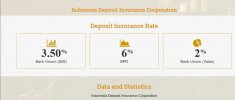
Is the savings account in IDR or a foreign currency? I checked a few minutes ago, and the maximum interest rate guaranteed by LPS is 3.5%. You could only get up to 6% if you saved your money in a BPR (Rural Bank). The equivalent interest rate in major foreign currencies is around 2%. So, by international market standards, you are actually losing money to inflation. The logic is simple while exchange rate fluctuate in a short term; In the long term the exchange rate of IDR vs other major currencies only moves to one direction.I'm considering withdrawing some rupiah and buying another house since I'm a bit worried about bank deposits versus a hard asset. That chunk of money would be taken from a Money Market account at 5%, (just forgotten and rolled over every 3 months.)
What do you think? Losing money at 5% since the rupiah has lost over 5% over 12 months.
Also, you need to be careful when reading Indonesian inflation statistics reported by BPS, the National Statistics Bureau.
Attachments
Last edited:
- Joined
- Oct 12, 2016
- Messages
- 729
Is the savings account in IDR or a foreign currency?
"I'm considering withdrawing some rupiah."
So, by international market standards, you are actually losing money to inflation.
"Losing money at 5% since the rupiah has lost over 5% over 12 months."
Thanks for the reply though.
Helpful Herbert
Well-Known Member
- Joined
- Mar 24, 2019
- Messages
- 1,863
Owning a house involves paying a lot of transaction costs (eg tax, notary), plus a lot of ongoing costs such as repairs and maintenance and also time.I'm considering withdrawing some rupiah and buying another house since I'm a bit worried about bank deposits versus a hard asset.
Also it is denominated in rupiah so it is also being devalued while the rupiah devalues. The net rent you would get from a tenant would probably work out at less than the net interest you would get from a bank deposit.
Also it doesn't seem like capital values of houses are really increasing these days over the last 10 years, or that they will in the next few years either.
One advantage of owning property assets such as a house is the ability to use leverage from banks or lenders. Typically, you only need to use around 10% of your own money as a deposit while borrowing the remaining 90% from the bank. This can work particularly well for a first home because it also eliminates the opportunity cost of paying rent.Owning a house involves paying a lot of transaction costs (eg tax, notary), plus a lot of ongoing costs such as repairs and maintenance and also time.
Also it is denominated in rupiah so it is also being devalued while the rupiah devalues. The net rent you would get from a tenant would probably work out at less than the net interest you would get from a bank deposit.
Also it doesn't seem like capital values of houses are really increasing these days over the last 10 years, or that they will in the next few years either.
Another advantage is the potential appreciation in value, especially if the property includes land ownership. But if you are a foreigner this will not be the case. In other countries you have leasehold of 99 years (extandable); But In Indonesia you will only have it for 30 years (extandable). To me, it is really a major disadvantage.
Also remember, property prices do crash and can decline in a short term, and risks such as tenants failing to pay rent or difficulties with eviction are not uncommon. In addition, addtional taxes for second home, administrative expenses and ongoing maintenance costs must also be taken into account.
The debate between owning property and investing in the stock market has existed for decades. No one has a crystal ball, but the general consensus is that maintaining a diversified portfolio is usually the most balanced approach.
Unless it is for a first home, where avoiding rent provides a clear financial benefit, I have rarely heard financial professionals recommend putting all of one’s hard-earned savings solely into property investments.
This is not financial advice. Everyone should make decisions based on their own research, goals, and beliefs.
Last edited:
Helpful Herbert
Well-Known Member
- Joined
- Mar 24, 2019
- Messages
- 1,863
I'm still convinced that you are just a bot producing chat GPT posts.One advantage of owning property assets such as a house is the ability to use leverage from banks or lenders. Typically, you only need to use around 10% of your own money as a deposit while borrowing the remaining 90% from the bank. This can work particularly well for a first home because it also eliminates the opportunity cost of paying rent.
Another advantage is the potential appreciation in value, especially if the property includes land ownership. But if you are a foreigner this will not be the case. In other countries you have leasehold of 99 years (extandable); But In Indonesia you will only have it for 30 years (extandable). To me, it is really a major disadvantage.
Also remember, property prices do crash and can decline in a short term, and risks such as tenants failing to pay rent or difficulties with eviction are not uncommon. In addition, addtional taxes for second home, administrative expenses and ongoing maintenance costs must also be taken into account.
The debate between owning property and investing in the stock market has existed for decades. No one has a crystal ball, but the general consensus is that maintaining a diversified portfolio is usually the most balanced approach.
Unless it is for a first home, where avoiding rent provides a clear financial benefit, I have rarely heard financial professionals recommend putting all of one’s hard-earned savings solely into property investments.
This is not financial advice. Everyone should make decisions based on their own research, goals, and beliefs.
And not even a very good bot, since the poster clearly said he wanted to buy another house not a first house and then you give him advice about getting a mortgage for a first house.
Try writing a response without using AI, because if you never use your own brain then eventually you won't be able to think for yourself anymore.


