
Not so much.Also the time of Merdeka sounds very familiar to the time of Pol Pot and the Khmer Rouge, in which all intellectuals were killed or imprisoned, or made to go work the fields.

INFORMATION AND COMMUNITY FOR EXPATS IN INDONESIA

You are using an out of date browser. It may not display this or other websites correctly.
You should upgrade or use an alternative browser.
You should upgrade or use an alternative browser.
Contemporary Art/Design in Indonesia
- Thread starter serious_fun
- Start date
It seems that fine arts do require excess wealth, otherwise who would buy or subsidize them?I'd say that the art market has been a place that required excess wealth ... societies that have excess wealth will invariably have collectors, galleries, well funded and professionally curated museums, etc.
BUT the fine arts do not require patrons. The fine arts do not require the excess wealth, although it would be wonderful to have genuine philanthropists who donate and otherwise support the fine arts.
Indonesia, it seems to me, was turned into a cultural wasteland during the great patriotic time of murder and terror, (merdeka! yippee!), where intellectuals had to flee or work in secret or be taken away in the dead of night... the loss of those intellectuals, in turn, led to a very noticeable lack of leading educators and/or figures who could help to nurture the next generation(s). We are here in the year 2024 and from what I can see, there is a very real and a very dangerous dearth of fine art in the daily life of Indonesians.* Obviously it's not just "creative industry" that needs this... engineering/architecture, basic problem solving, new business ventures, corporate leadership, common sense urban planning, etc., etc.
Perhaps the lack of intellectuals as role models is exacerbated by cultural norms/religious or superstitious beliefs/low IQ and a horrible 'education' system/etc. (I'm trying to be diplomatic), but a society that doesn't seem to celebrate the fine arts beyond batik and dangdut is in danger of remaining a stagnant place for youth. And a stagnant place for visitors (and expats [me]) who may be accustomed to having access to vibrant arts organizations and museums, trained art educators, regular art exhibitions around the community, art supplies easily found in shops, etc.
You may notice that I never mentioned corruption; how would patronage of the fine arts work in Indonesia? Ooops! I mentioned corruption.
Things move slowly. I'm encouraged by the few organizations and schools that are working towards a better future for the fine arts in Indonesia. Please visit one or more of the URLs which I've posted above...there are some great things happening! Maybe even outside of Jakarta/Bandung/Yogya!
*I do not live in Jakarta/Bandung/Yogya.


I've seen no evidence that independence stifled intellectual thought here. It was after all Indonesian intellectuals who led the movement to independence. Are you confusing the late 1940's for the mid 1960's by any chance?
We can look too at the rise in materialism and the spread of low Western culture through television and movies as reasons that traditional fine art has declined. Why go to wayang kulit when you can watch John Wick in your living room? Also affordable mass produced goods are made with little consideration for art.
The base religions are still pretty much the same and the educational system hasn't gotten a lot worse in the last 50 years so I don't know if we can point there.
Thanks for posting those URL's!

- Joined
- Oct 12, 2016
- Messages
- 693
My apologies if my earlier post about what I perceive to be a dearth of Fine Arts in daily life here seemed overly critical or negative.
The comments were not meant as a general criticism of Indonesian culture or Indonesian people, but rather as a tangent stemming from what I perceive to be a dearth of Fine Arts in daily life here. (redundant yet?)
My opinion is that a society which has a solid foundation in the Fine Arts will see the benefits in other disciplines, not just the so-called 'Creative Industries'. Road design/civil engineering/traffic control are disciplines that, (I think that we all agree), need some of the problem solving skills that the Fine Arts helps to develop. Just my opinion.
Regarding the issue of patronage, it is complex. It is and has been used/abused for political or social gain and it is closely linked to the Art Market which I detest.
I make a distinction between the Art Market and the Fine Arts.
A group of lovely 5 year olds drawing with crayon or oil pastels? Fine Art!
A hobbyist working with modeling clay? Fine Art!
A person sketching a rough draft of a design? Fine Art!
A few children working together to make a funny animation? Fine Art!
Senior citizens capturing video or photos of something interesting? Fine Art!
There is no actual utilitarian function there, per se, and there is no thought, generally, of financial gain.
Perhaps a shopping mall or a coffee house will hold an exhibition of amateur work.
Perhaps a parent will donate a case of drawing pads to their child's school.
This is what I refer to.
This is what I do NOT see in my community, despite their being a large number of schools here...I am not used to what I perceive to be a dearth of Fine Arts in daily life here.
Apologies once again if my earlier post(s) seem overly critical or negative. There are dedicated artists here who are passionate and motivated and THEY are playing a vital role in the development of the nation. (That sounds like an campaign speech! ) I just don't see it happening in my community.
The comments were not meant as a general criticism of Indonesian culture or Indonesian people, but rather as a tangent stemming from what I perceive to be a dearth of Fine Arts in daily life here. (redundant yet?)
My opinion is that a society which has a solid foundation in the Fine Arts will see the benefits in other disciplines, not just the so-called 'Creative Industries'. Road design/civil engineering/traffic control are disciplines that, (I think that we all agree
), need some of the problem solving skills that the Fine Arts helps to develop. Just my opinion.Regarding the issue of patronage, it is complex. It is and has been used/abused for political or social gain and it is closely linked to the Art Market which I detest.
I make a distinction between the Art Market and the Fine Arts.
A group of lovely 5 year olds drawing with crayon or oil pastels? Fine Art!
A hobbyist working with modeling clay? Fine Art!
A person sketching a rough draft of a design? Fine Art!
A few children working together to make a funny animation? Fine Art!
Senior citizens capturing video or photos of something interesting? Fine Art!
There is no actual utilitarian function there, per se, and there is no thought, generally, of financial gain.
Perhaps a shopping mall or a coffee house will hold an exhibition of amateur work.
Perhaps a parent will donate a case of drawing pads to their child's school.
This is what I refer to.
This is what I do NOT see in my community, despite their being a large number of schools here...I am not used to what I perceive to be a dearth of Fine Arts in daily life here.
Apologies once again if my earlier post(s) seem overly critical or negative. There are dedicated artists here who are passionate and motivated and THEY are playing a vital role in the development of the nation. (That sounds like an campaign speech! ) I just don't see it happening in my community.
- Joined
- Oct 12, 2016
- Messages
- 693
Galeri Ruang Dini (in Bandung)
Black Hand Gang printmaking studio (in Ubud)
a few articles about Maryanto:
Maryanto’s Sense of Dread
brief review of Maryanto
Black Hand Gang printmaking studio (in Ubud)
a few articles about Maryanto:
Maryanto’s Sense of Dread
brief review of Maryanto
Last edited:
- Joined
- Oct 12, 2016
- Messages
- 693
- Joined
- Oct 12, 2016
- Messages
- 693
??? Why do you regularly hijack threads on this website?I understand that this topic is diverting from the original thread...
NO, those were protests. They are not related to 'art & painting'. (sigh)The vandalism attack on the Mona Lisa painting at the Louvre Museum in Paris is at least more pertinent to this thread, as it relates to the original discussion about art and painting.
God, please give me patience.Furthermore, in today's interconnected world, it's not unusual in discussion forums to draw comparisons with practices from other countries.
This thread is identified in the following way:
Living in Indonesia
 Indonesian Language and Culture Contemporary Art/Design in Indonesia
jstar
Mr. 10,000
- Joined
- Jul 31, 2016
- Messages
- 6,413
Often there are art exhibitions and auctions in the building of the Kunstkring in Menteng. Some semi permanent. Quite interesting, mainly Indonesian artists.
A Salmon and Beer Festival is also not bad of course.
A Salmon and Beer Festival is also not bad of course.
- Joined
- Oct 12, 2016
- Messages
- 693
- Joined
- Oct 12, 2016
- Messages
- 693
Hyphen— , co-initiated in 2011 by Ratna Mufida, Pitra Hutomo, and Grace Samboh as a sustainable conversational space regarding aesthetic practices. Not long after, that space expanded through engagement in various artistic activities, including exhibition-making, various forms of publishing, archiving, research, open-ended conversations, karaoke, barbecue nights, feasts, etcetera. Hyphen— aims to put forward curiosity and people’s common wellbeing as the estuary of artistic practices. They were joined by Akmalia Rizqita “Chita” and Rachel K. Surijata (in 2020); as well as Ruhaeni Intan and Andri Setiawan (in 2023).
They currently play with explorations on the practices of Gerakan Seni Rupa Baru Indonesia (Indonesia New Art Movement, 1975-1989), Kustiyah (1935-2012), and Danarto (1940-2018); exhibition histories surrounding Kesenian Indonesia (Indonesian Art, 1955), BINAL Experimental Arts (1992), Contemporary Art Exhibition of the Non-Aligned Countries (1995); while attempting to unravel Indonesia’s so-called national history through its visual representations.
- Joined
- Oct 12, 2016
- Messages
- 693
Rubanah Underground Hub in Menteng, Jakarta
- Joined
- Oct 12, 2016
- Messages
- 693
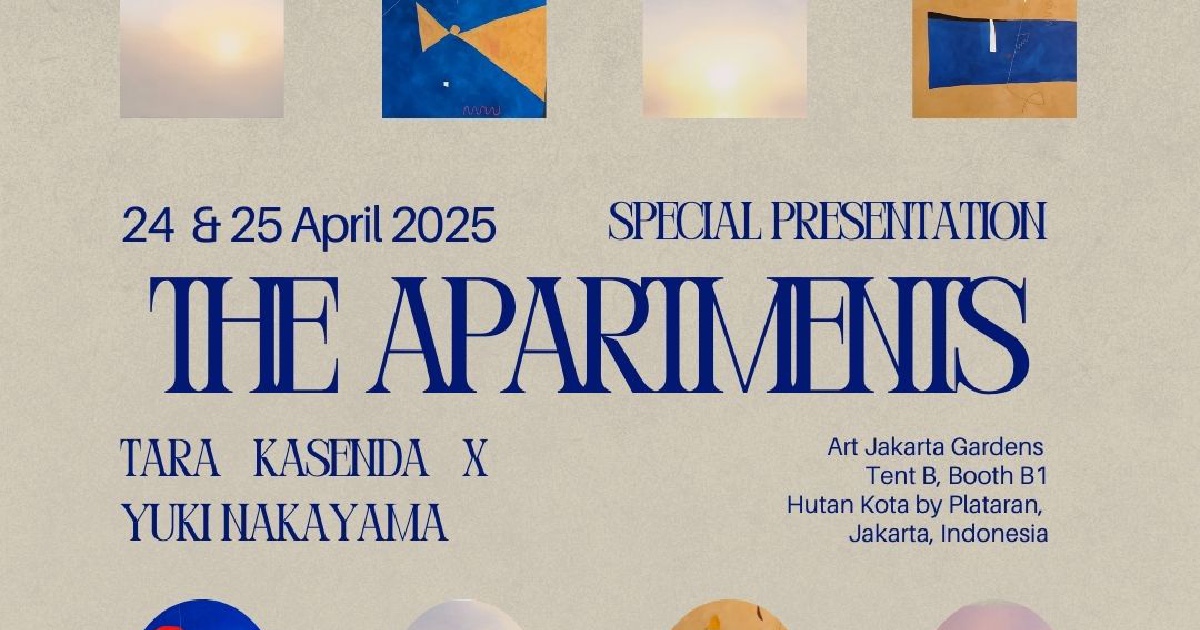
Art Jakarta is happening soon at "Hutan Kota by Plataran" (Jakarta's Gelora Bung Karno complex)
22 Apr 2025
(by invitation only)
1 – 9 PM
23 – 25 Apr 2025
1 – 9 PM
Saturday – Sunday
26 – 27 Apr 2025
11 AM – 9 PM
VIP PREVIEW
Tuesday22 Apr 2025
(by invitation only)
1 – 9 PM
PUBLIC DAYS
Wednesday – Friday23 – 25 Apr 2025
1 – 9 PM
Saturday – Sunday
26 – 27 Apr 2025
11 AM – 9 PM
- Joined
- Oct 12, 2016
- Messages
- 693
* Not exactly on topic, but there's a Cartoon Art show on 17th May, 2025, details here. I also attached a screenshot.
* ICAD Open Call : Indonesian Contemporary Art and Design (ICAD) 15 invites you to submit your concept with a focus on the theme “Earth Society”.
Deadline: Saturday, 31 May 2025
* ICAD Open Call : Indonesian Contemporary Art and Design (ICAD) 15 invites you to submit your concept with a focus on the theme “Earth Society”.
Deadline: Saturday, 31 May 2025
Attachments

- Joined
- Oct 12, 2016
- Messages
- 693
MR.D.I.Y. Indonesia Art Competition 2025 , information at the URL provided.
- Joined
- Oct 12, 2016
- Messages
- 693
A new gallery in Jakarta !
ara contemporary
Jl Tulodong Bawah I, No. 163, Senayan
Kebayoran Baru, Jakarta Selatan 12190, Indonesia
+62 858 1477 2558 | [email protected]
recent articles regarding ara contemporary:
In Flux and In Focus: Embracing Beginnings through Ara Contemporary’s Opening
To Grow Alongside the Scene: On ara contemporary and Southeast Asia Practices
ara contemporary
Jl Tulodong Bawah I, No. 163, Senayan
Kebayoran Baru, Jakarta Selatan 12190, Indonesia
+62 858 1477 2558 | [email protected]
recent articles regarding ara contemporary:
In Flux and In Focus: Embracing Beginnings through Ara Contemporary’s Opening
To Grow Alongside the Scene: On ara contemporary and Southeast Asia Practices
- Joined
- Oct 12, 2016
- Messages
- 693

jstar
Mr. 10,000
- Joined
- Jul 31, 2016
- Messages
- 6,413
ISA Art: "A Fold in Time"
A Fold in Time is a contemporary art exhibition in Jakarta, running from 15 April to 20 June 2025. It's a collaborative effort between MONO8 Gallery (Manila), Richard Koh Fine Art (Singapore/Bangkok) and the ISA Art Gallery (Jakarta). The exhibition features female artists from Southeast Asia and beyond.
 www.isaartanddesign.com
This exhibition takes place from April 15 - June 20, 2025 at ISA ART, Wisma 46 Jakarta. The gallery was started by a lady who has worked for Christie’s and Sotheby’s before.
A Fold in Time is a contemporary art exhibition in Jakarta, running from 15 April to 20 June 2025. It's a collaborative effort between MONO8 Gallery (Manila), Richard Koh Fine Art (Singapore/Bangkok) and the ISA Art Gallery (Jakarta). The exhibition features female artists from Southeast Asia and beyond.
A Fold in Time at ISA Art Gallery | 15 April - 20 June 2025
Aimi Kaiya, Eunice Sanchez, Goldie Poblador, Ines Katamso, Issay Rodriguez, Jill Paz, Kelli Maeshiro, Liu Hsin-Ying, Luh'De Gita, Rose Cameron, Sinta Tantra, and Wah Nu. "A Fold in Time" is a collaboration among contemporary art galleries based in Southeast Asia– MONO8 (Manila) , ISA Art Gallery...
www.isaartanddesign.com
This exhibition takes place from April 15 - June 20, 2025 at ISA ART, Wisma 46 Jakarta. The gallery was started by a lady who has worked for Christie’s and Sotheby’s before.
- Joined
- Oct 12, 2016
- Messages
- 693
Inside the art auction
Here is the auction website in case you're curious. I'm not soliciting or promoting for them, just linking to some Indonesian artworks.
Global Auction brought together a rich mix of works by Indonesian masters and contemporary voices.
Here is the auction website in case you're curious. I'm not soliciting or promoting for them, just linking to some Indonesian artworks.
- Joined
- Oct 12, 2016
- Messages
- 693


- Joined
- Oct 12, 2016
- Messages
- 693
Users who viewed this discussion (Total:8)
Follow Us
Latest Expat Indo Articles
Latest Tweets by Expat Indo
Latest Activity
New posts Latest threads
-
Latest Posts
-
-
Latest Threads
-
Difficulty contacting new Immigration Office in Banyuwangi . (5 Viewers)
- Started by Nicho
- Replies: 16
-
Indonesian National – Experienced Driver & Personal Admin Seeking Opportunity (West Jakarta)
- Started by Andi1975
- Replies: 2
-
 Used house surprises, even 10 years later
- Started by Jaime C
- Replies: 10
-

-
Shortage of 498,000 teachers in Indonesia next year?
- Started by serious_fun
- Replies: 33
-


